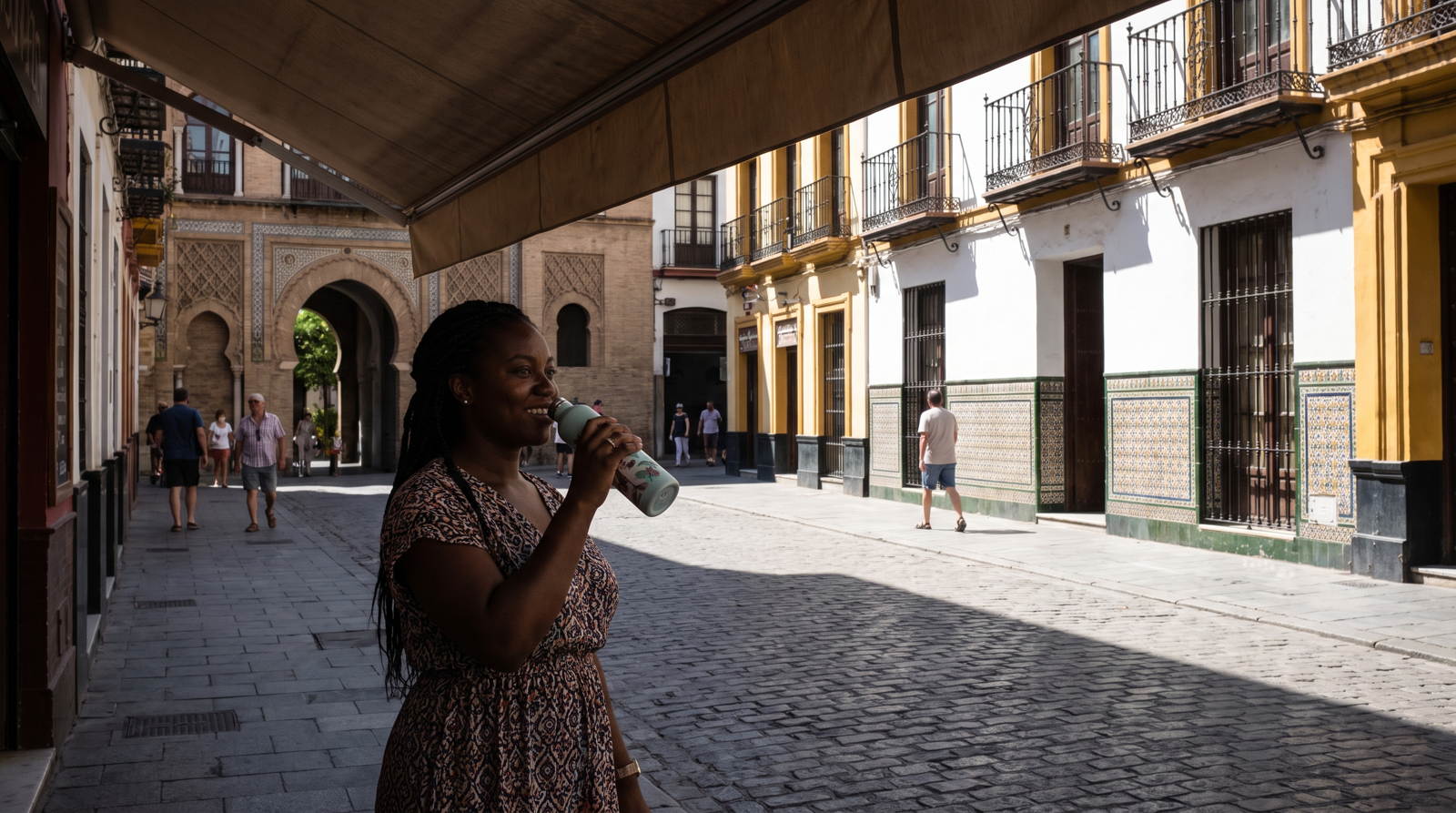
It is half past one in the afternoon. You have three things left on today's list. It is hotter than you expected, but the next place is only a twenty minute walk, so you keep going.
Nobody beside you says that is a bad idea. Nobody notices you have gone quiet. Nobody questions the decision, because you are the only person making it.
That is what heat changes when you travel alone. Not the temperature. The number of people paying attention.
This does not make summer solo travel dangerous. It means heat changes the shape of a day. When you are by yourself, you are the only one who can decide to change it.
Too Hot Is Not a Temperature
I should be straight with you about my own position, because it affects everything I could tell you here.
Heat has never been a problem for me. I grew up in Curaçao, so what registers to somebody else as extreme is simply what weather is. The Dominican Republic felt the same. I chase the sun deliberately, and I know what I am signing up for.
That is not a virtue. It is a baseline, and I did not earn it. I got it from where I was born.
Which is the first useful thing in this article. There is no universal too hot. The line is personal, and it is set largely by what your body has spent its life doing. Put me and a woman from a cool northern country on the same street at 33°C (91°F) and we are having two different afternoons. Same reading, different bodies.
So do not calibrate off other travelers. Do not calibrate off me. The comparison that matters is you against your own normal, not you against somebody who looks fine.
Humidity does a lot of the work here too, and the forecast number hides it. 38°C (100°F) in dry air and 30°C (86°F) in heavy humidity are not the same afternoon. Sweat is how your body sheds heat, and humid air makes that far less effective. Many weather services publish a heat index or feels-like figure alongside the temperature for exactly this reason. That is the number worth reading.
A High Tolerance Is Not Immunity
Here is the only time heat has ever actually bothered me, and it did not happen anywhere tropical.
It happened in the Netherlands, which is my second home. There was a heatwave, with temperatures between 35°C and 39°C (95°F to 102°F). Curaçao sits around 32°C (90°F) and stays there.
So that summer, the Netherlands was hotter than the place I grew up has ever been.
I did not find it unbearable. What I noticed was that I was aware of it, which is not something heat usually does to me. It registered as considerably hotter than anything I am used to, and I had to think about it.
That is the point worth taking. My tolerance is high and it still has a ceiling, because a body adapts to a range rather than to heat in general. Whatever your range is, there is a number above it.
There was a second thing stacked on top. The Netherlands is not a hot country, so very little there is set up for that kind of weather. Air conditioning is uncommon, buildings were designed to hold warmth in rather than keep it out, and the day carries on exactly as it would at 20°C (68°F).
Somewhere that is used to heat behaves differently. Shade, thick walls, shutters closed through the afternoon, and a habit of not doing very much in the middle of the day.
So there are two things to check before a summer trip. How hot it will be against what your body is actually used to. And whether the place you are going is set up for it at all.
A hot country usually is. A country having an unusual heatwave usually is not, and that gap is where people get caught out.
What Changes When Nobody Is With You
Now the solo part, and I want to be accurate rather than dramatic about it.
The research on heat and thinking is real but more mixed than the internet suggests. High temperatures have been shown to affect attention, memory and executive function. The size of the effect varies with how long you are exposed, how complex the task is, and who you are.
The finding that matters most for a solo traveler is a quieter one. In at least one study, people's performance held up while they reported feeling more distracted and under more load. They were burning extra effort to stay level, without registering it as impairment. Research has also found that what people report about their own performance in heat is a poor guide to their actual performance.
Put plainly. You are not a reliable judge of how well you are coping.
With another person, that gets solved without anybody trying. They notice you have stopped talking. They notice you are slower. They say let us sit down, or that is enough, or we are getting a taxi. You do not have to assess yourself, because somebody else is doing it for free.
Alone, that loop is gone. The only person evaluating whether you should keep walking is the person who has been in the sun for four hours.
This is the same missing redundancy as the solo travel emergency plan, just at the scale of a single afternoon.
The Itinerary Does Not Get a Vote
The plan is the thing that gets in the way here, and it is worth understanding why it has such a grip.
You paid for the flights. You have three days. The ticket was expensive and timed. You built this itinerary at home with real care, and finishing it feels like the point.
I have written about this from the other direction in the trip I planned for a version of myself that does not exist. The lesson is the same. An itinerary is supposed to serve the traveler, not the other way around.
None of that makes it a good plan today. A thirty dollar ticket does not become more valuable because it is 39°C outside, and pushing through does not recover the money. It just makes an expensive trip less pleasant.
There is an extra pressure on a first solo trip specifically. You finally did it, you finally came alone, and some part of you wants to prove you can handle it. So going back to the room at two in the afternoon feels like failing.
It is not. Your accommodation is not somewhere you are only allowed to return to once the sightseeing is finished. If the conditions call for a break, the break is part of the day rather than an interruption to it.
Being good at solo travel is not completing the list regardless of conditions. It includes knowing when today's plan has stopped making sense. Nobody is going to give you permission to change it, which means you have to be the one who does.
Plan Around the Hours, Not Just the Place
The practical version of all this is small.
Before each day, look at how the conditions actually develop rather than at the single maximum figure. When does it peak. When does it ease. Local meteorological services are the right source for this, and most of them publish warnings that are more specific than a general forecast app.
Then look at where your most exposed plans sit. Long walks, outdoor sites, viewpoints, markets and anything without shade are worth moving toward the cooler ends of the day. The middle can hold the indoor things, the long lunch, the museum, the slow transfer between places.
I am deliberately not giving you hours to avoid. That varies by country and by climate, and local guidance is better than mine.
The principle is that the shape of the day is adjustable and the destination is not. Most people plan the where in enormous detail and the when not at all.
The Day Cooling Down Does Not Mean Your Room Does
Worth checking before you book, and almost nobody does.
Buildings that were designed to hold heat in are very good at their job. A place that has been absorbing sun since morning can stay warm long after the street outside has cooled, which is the same reason a heatwave is harder in a country that never planned for one.
So look at what your accommodation actually offers, not just where it is. Air conditioning, a fan, shutters, which direction the room faces, whether the windows open. On a hot trip that matters more than the view.
The reason is not comfort. It is that a night you do not recover from turns into a day you handle worse, and if you are traveling alone, tomorrow's judgment is the only judgment on the trip.
Have a Plan B That Is Not Sitting in Your Room Being Annoyed
People resist changing plans when the alternative feels like losing the entire day.
So decide what the alternatives are before you need them. Not specific places, just categories. What is indoors here. What runs in the evening. What is a good slow afternoon rather than a wasted one.
If you know that in advance, dropping plan A costs you very little. If you do not, changing the plan feels like a punishment, so you push on instead.
Heat Changes the Transport Math Too
A small one that catches people out.
It is only a twenty five minute walk is a sentence you say at home, looking at a map, in a different temperature. Under real heat that is a different proposition, and so is a long wait on an exposed platform.
Nothing about that decision has to be brave. Take the taxi. Take the metro. The version of the itinerary you designed at your kitchen table does not get the final say. The conditions you are standing in do.
The Medical Part Is Not Mine
I am not going to give you my version of how to recognize heat exhaustion or heatstroke. Not the warning signs, and not what to do about them. I am a solo travel coach. That is a matter for doctors and public health authorities, and their guidance is current in a way an article is not.
What I will say is why it matters more when you are alone. In a group, somebody else usually spots it first, because the early signs are more visible from the outside than they are from the inside. On your own, nobody is watching, and you have already read above why your own assessment is not fully trustworthy in that state.
So read the official guidance from a health authority before you go somewhere hot. Then find out where local emergency information lives once you are there. That is a ten minute job and it is the right ten minutes.
Decide Your Rules Before You Are Hot
Rational decisions are much easier to make three weeks in advance, from a cool room. Considerably harder on a street at two in the afternoon with two things left on the list.
So make some of them now.
Decide in advance that an official heat warning means the day gets restructured, not debated. Decide that if a planned outdoor activity no longer makes sense, you will move or drop it rather than negotiate with yourself. Decide what your version of a rest break looks like, so that taking one does not feel like a defeat when the moment comes.
None of these are medical thresholds and I am not inventing any. They are planning rules, and their only job is to make changing your mind an outcome you have already agreed to.
One last thing. This does not need three weeks of research. Check what is forecast, check what local authorities are advising, decide what it changes about your day, then get on with it. The same test applies here as everywhere else, which is whether the information changes what you would reasonably do. There is more on that in how to research what actually happens where you are going.
Extreme heat does not become a different physical event because you are alone. What changes is the system around you. Nobody notices you slowing down, nobody suggests abandoning the walk, and nobody looks at you and decides it is time to get somewhere cooler.
So you build a bit of that judgment into the plan before you leave. Check the hours, not just the place. Know what plan B is. Take the taxi. Get the medical part from people who know it.
Changing your itinerary is not failing at solo travel. It is usually a sign you are getting good at it.
Frequently Asked Questions
Is it safe to travel alone during a heatwave? For most healthy adults it is manageable with planning. What counts as manageable depends on your own tolerance, and on whether the destination is built for heat. The specific risk of traveling alone is that nobody else is there to notice you are struggling. The plan has to do that job instead.
How should I plan a solo trip during extreme heat? Plan around the hours rather than only the destination. Move exposed outdoor activities toward the cooler parts of the day, put indoor plans in the middle, and know your alternatives before you need them. Check local forecasts and warnings daily rather than relying on the single maximum number.
What should I do differently when traveling alone in hot weather? Build in the checks a travel companion would provide automatically. Decide your break points in advance and know where your next indoor stop is. Agree with yourself beforehand that changing the plan is an acceptable outcome, rather than something to argue about in the moment.
Should I cancel a trip because of extreme heat? Usually the choice is not between going and cancelling. A heatwave changes the shape of a trip more often than it ends one. If you do consider changing or cancelling, check what your policy allows first. What your insurance does when a region is disrupted depends heavily on when you bought it.
What time of day should I sightsee in very hot weather? That depends on the climate and on local guidance, which is more reliable than any general rule. The principle is to look at how the day develops rather than at the peak figure. Then put your most exposed plans where the conditions are most forgiving.
Where can I find reliable extreme heat advice while traveling? Local meteorological services for conditions and warnings, and health authorities for anything medical. Those are the two sources worth having bookmarked before you go, and they are more current than any travel article, including this one.
If the practical side of a trip keeps expanding until booking feels impossible, that is worth understanding.
Take the free 2-minute quiz and find out what is actually holding the decision.
Jordyn