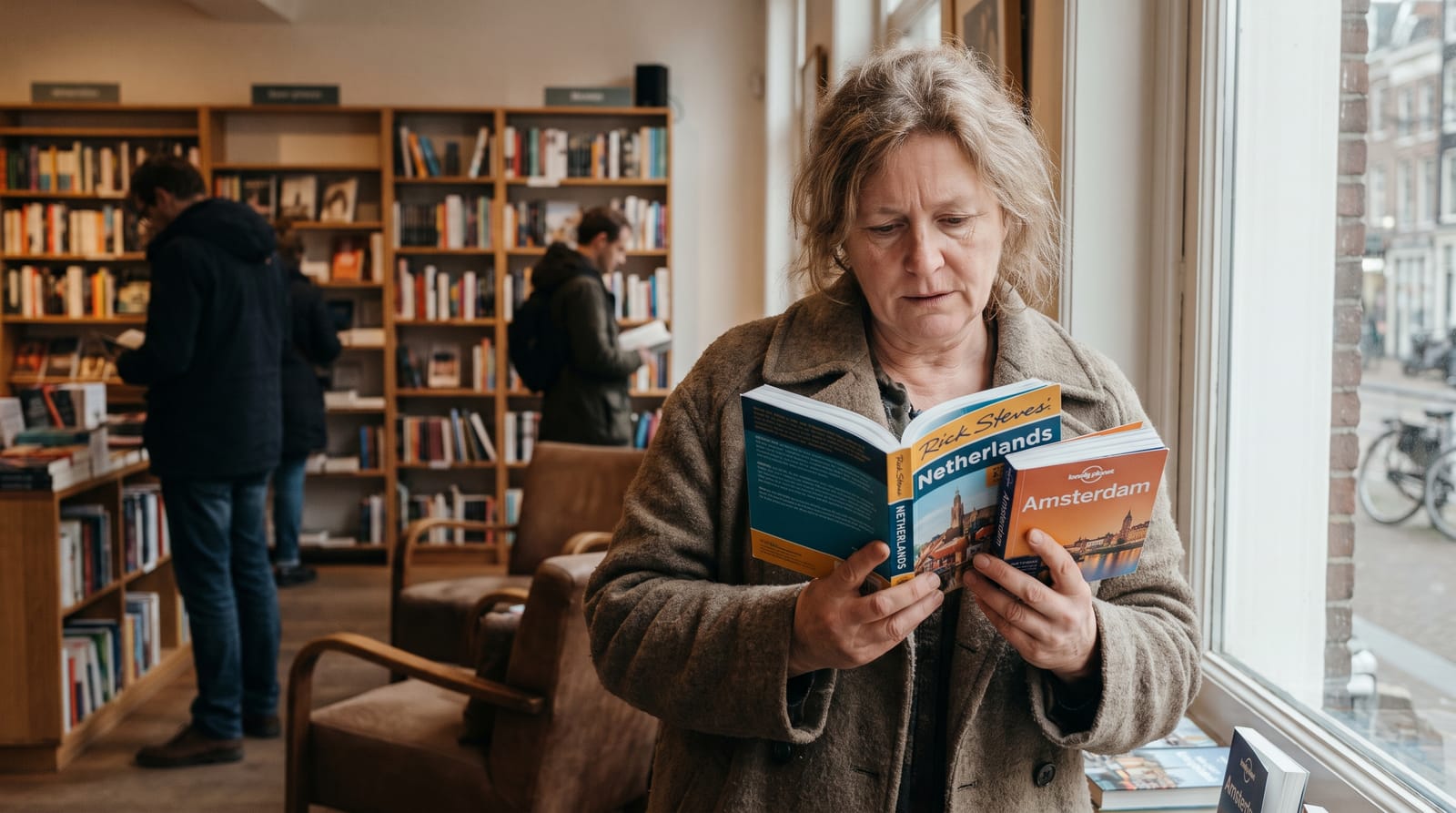
You decide you are finally doing this. Then you open Google, and the internet hands you forty answers.
Iceland. Japan. Portugal. Thailand. Croatia. Singapore. Every list is confident. No two lists agree. Somewhere around the fifth article you close the laptop, and the trip goes back on the shelf for another month.
If you are trying to choose your first solo travel destination, you are asking a reasonable question. You are just asking it in a form that has no answer.
Because there is no best first solo travel destination. There is only the one that fits the woman booking it, and no list on the internet knows anything about her.
This article will not give you a country. It will give you something more useful, which is a way of thinking about the choice that stops you spinning.
Why Every List You Have Read Disagrees
There is a reason the recommendations contradict each other, and it is not that some of the writers are wrong.
They are ranking different things.
One list is built on crime statistics. Another on how widely English is spoken. Another on cost, or public transport, or how photogenic the place is, or how easy it is to meet other travelers. Each one produces a completely different winner, and each one is internally reasonable.
None of them are measuring the thing that actually determines whether your first trip goes well.
That thing is fit. How much unfamiliarity you can absorb right now, at your current level of experience, without the trip becoming something you endure instead of enjoy.
No article can rank that, because it is different for every woman reading. Which is why you can read fifteen guides and end up less decided than when you started.
The lists are not failing you. You are asking them a question they were never built to answer.
Stop Looking for the Best Destination
Take the word best out of it entirely.
Best implies there is one correct answer that applies to everyone. It suggests some country out there is objectively right for a first solo trip. There is not. A place that would be perfect for one woman would be a miserable week for another, and neither of them chose wrong.
What actually varies is what you are comfortable with. How much uncertainty sits well with you. How you feel about not understanding the language around you. Whether long flights drain you. Whether you like cities or find them exhausting. How much planning you enjoy and how much you resent.
None of that is on a list because none of it is about the destination. It is about you, and you are the variable every guide leaves out.
Your first trip is not an audition. You are not being scored on how adventurous the location was. Nobody is going to check.
Your First Trip Should Build Confidence, Not Test It
Here is the thing worth understanding before anything else. The job of your first solo trip is to produce evidence.
Not a story. Not a set of photographs that impress people who doubted you. Evidence, for you, that you can be somewhere unfamiliar on your own and handle what comes up.
That is the entire assignment. Everything else is decoration.
Which means the question is not how impressive the destination is. It is how likely this particular trip is to end with you thinking that you would do it again.
A lot of women accidentally get this backwards. They pick something ambitious because a modest first trip feels like it does not count. Three countries in ten days. A long haul flight into somewhere with an unfamiliar alphabet and a transport system that takes locals a while to learn. Culture shock, jet lag, and total responsibility, all arriving in the same afternoon.
Sometimes that goes beautifully. Often it produces a woman who comes home exhausted, quietly concludes that solo travel is not for her, and never books another one.
That is the real risk with a first destination. Not danger. A bad first experience that closes the door.
A first trip that stretches you slightly is worth far more than one that overwhelms you impressively.
My own first solo trip was a weekend in Düsseldorf, reached by train. The culture was close enough to my own that almost nothing surprised me. It is not a story that impresses anyone at a dinner table. It did the job it was supposed to do, which was to prove the point so that the next one could be bigger.
Do Not Make Your Dream Destination the Practice Trip
This one costs women more than any other mistake, and almost nobody warns them about it.
You have a place you have wanted to see for years. The Pinterest board. The one you check flights for even when you have no intention of booking. The obvious move is to make that your first solo trip, because if you are finally doing this, why not do the one that matters?
Because the one that matters carries too much weight.
When a trip has been a dream for ten years, it cannot just be a trip. Every hour has to justify a decade of anticipation. A rainy day is not a rainy day, it is the dream going wrong. Getting lost is not an inconvenience, it is you ruining the thing you waited for. A mediocre meal becomes evidence that you have wasted it.
You will also be handling first time solo nerves at the same time, which means you are unlikely to experience the place properly anyway. You get the destination without being present for it.
There is a second problem. Fear behaves differently when the stakes are high. If this trip is enormous in your mind, the resistance to booking it will be enormous too. That is often exactly why the dream destination has stayed a dream. It is not that you never wanted it enough. It is that you made it too important to risk.
Save it. Go there as a woman who has already done this once and knows what she is like on her own. It will be a better trip, and you will actually be there for it.
The Two Ways Women Choose Wrong
Most bad first destinations come from one of two directions, and they look like opposites.
Choosing to prove something. The trip gets selected for how it sounds rather than how it will feel. Somewhere difficult, remote, or impressive, chosen partly for the people who said she could not do it. The audience is always in the room. The problem is that a trip chosen as an argument has to win, and holidays are not good at winning arguments.
Choosing from fear. The opposite move. Somewhere so managed, so familiar, so completely without friction that nothing is asked of her at all. A week in a place where she never has to make a real decision.
The second one looks sensible, and it is the sneakier failure. A trip with no stretch in it produces no evidence. You come home having proved that you can be somewhere pleasant. You already knew that. The fear about actual solo travel is exactly where you left it.
There is a version of playing it safe that is genuinely smart, and a version that is fear wearing sensible shoes. The difference is whether anything was asked of you.
One more thing worth saying. Choose for who you actually are, not for who you think you should be on holiday. Women who hate sitting still book restful beach weeks, because that is what a good holiday is supposed to look like. Then they spend five days bored and disappointed in themselves. Your real personality does not stay behind at the airport.
What a Destination Cannot Do for You
It is worth being honest about the limits of this decision, because you may be asking it to carry more than it can.
The right destination will not make you unafraid. There is no country where the nerves do not show up. If you are hoping to find a place easy enough that booking feels comfortable, you will keep searching, because that place does not exist.
The right destination also will not make you ready. Readiness is not something a location provides.
And no amount of research will tell you how a place will actually feel. You can read every review of a city and still not know whether you will like it. That depends on things no reviewer can transmit. The weather that week. Your mood. Whether your feet hurt on the second day.
Choosing well reduces friction. It does not remove uncertainty, and it was never going to.
Why You Still Cannot Decide
Here is the part worth sitting with.
You have been comparing destinations for weeks. Every option gets ruled out for a reason that sounds practical. The problem is probably not that you lack information.
Watch the pattern. One place is too far. The next is too expensive. The next has a language issue. The next is in the wrong season. Each objection is individually reasonable. Together they have produced no booking, month after month.
That is not a research problem. Research problems get solved by research.
Comparing destinations is comfortable. It feels like progress, it costs nothing, and it can continue indefinitely without ever requiring you to commit. Choosing ends it. Which is why, for a lot of women, the choosing never quite finishes.
If that describes your last six months, the destination was never really the question.
So, How Do You Choose Your First Solo Travel Destination?
Stop asking which country is best. Nobody can answer that, including the people who confidently do.
Ask this instead. Which trip gives me the highest chance of coming home thinking I would do that again?
That is a different question, and unlike the first one, only you can answer it. It takes your experience into account, your tolerance for uncertainty, your budget, your actual personality rather than your aspirational one.
Your first destination does not have to become your favorite. It does not have to be remarkable, and it does not have to convince anybody of anything.
It only has to be the place where you find out what you are like on your own. Everything after that gets easier, and everything after that can be as ambitious as you want.
Frequently Asked Questions
What is the best first solo travel destination? There is not one, and any article that names a single country is answering a different question than the one you asked. What makes a destination good for a first trip is how well it matches your experience and your tolerance for the unfamiliar. That varies enormously between two women reading the same list.
Where should I go on my first solo trip? Somewhere that stretches you a little and does not overwhelm you. The measure is whether you are likely to finish the trip wanting to book another one. That is the only outcome that matters on a first trip.
Should my first solo trip be close to home? Proximity does more work than most people expect. It lowers the cost of everything going wrong. Shorter flights, easier logistics and a familiar time zone mean any problem stays a small problem. It is not a requirement. It is simply the setting where a first trip is most likely to go well.
Is it better to start with a city or a beach destination? Depends entirely on which one you actually enjoy. The honest question is not which is easier, it is whether you like having things to do or genuinely relax with nothing scheduled. Booking the version of a holiday you think you should want is one of the most common ways a first trip disappoints.
How long should my first solo trip be? Long enough to get past the first day, which is the hardest one. Beyond that there is no correct number. Length matters far less than whether the trip suits you, and a short trip that goes well beats a long one you spend counting down.
How do I choose when I keep changing my mind? Look at whether options are being ruled out on new information, or on new objections. If every candidate develops a fatal flaw shortly after you start liking it, the difficulty is not the shortlist.
If you have been comparing countries for months and still have not booked, another destination guide is not the missing piece.
Take the free 2-minute quiz and find out what is actually holding the decision.
Jordyn